

How AI Agents Think: Function Calling, ReAct Loops, and Tool Autonomy

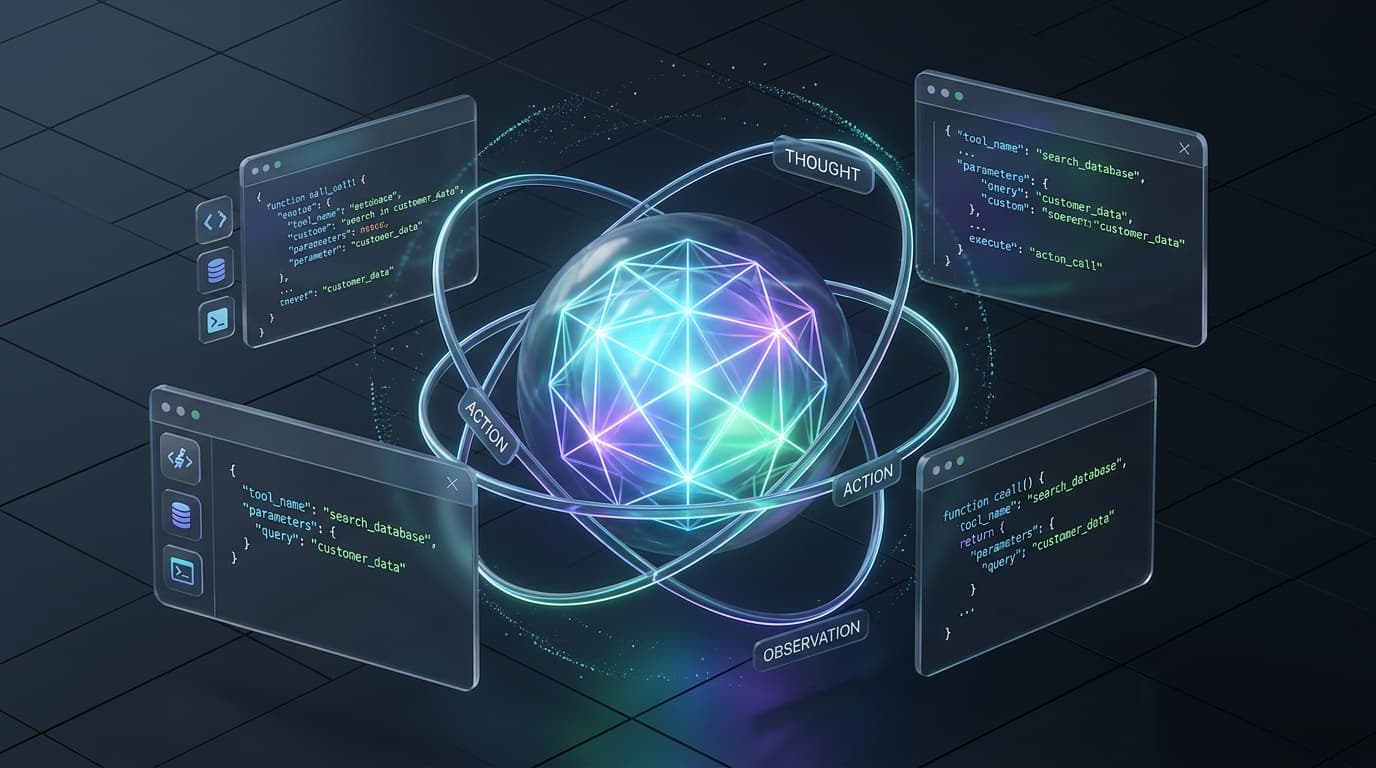
Beyond Chat: Giving Models Hands and Eyes
A standard conversational chatbot is stateless: it receives text, computes token probabilities, and spits out text. An <strong>AI Agent</strong>, by contrast, possesses agency: the ability to perceive an environment, reason through intermediate goals, execute real-world actions via tools, and self-correct when an error occurs.
The Heart of the Agent: The ReAct Pattern
Almost all autonomous agents (including coding assistants like Claude Code, Antigravity, and LangChain agents) run on a cyclical pattern known as ReAct (Reason + Act):
Thought: Analyze the current state and determine the next logical step.
Action: Select a registered tool and format its input arguments (Function Calling).
Observation: Inspect the output returned by the tool (terminal logs, API response, file content).
Repeat: Iterate until the goal is satisfied or a dead-end is reached.
Deterministic Function Calling
How does an LLM execute a command or edit a file without guessing? Modern models are trained to output structured JSON matching formal schemas.
For example, when an agent wants to inspect a file, it does not invent an imaginary answer. It emits a structured tool call:
{ "tool": "view_file", "parameters": { "filePath": "c:/Users/Ningmei/Documents/GitHub/osh/package.json", "startLine": 1, "endLine": 30}}The host environment intercepts this JSON, safely executes the filesystem read, and injects the actual file contents back into the model's context as the next prompt.
The Real Challenge: Error Recovery & Loops
What separates a toy script from a production agent is how it handles failures. If an agent runs
npm run testand a unit test fails, a naive bot stops and apologizes. A true agent reads the stack trace, parses the line numbers, inspects the failing module, forms a hypothesis, applies a diff, and re-runs the test until it turns green.
Mastering tool boundaries, preventing infinite loops, and keeping context windows clean is the defining software engineering discipline of this decade.
0 comments
Sign in to join the conversation. Rest assured, your information is secure. See my privacy policy for more.
No comments yet. Be the first to share your thoughts.